Categories
edci338 Posts

Week Eleven: Engaging Your PLN

How likely individuals are going to continue with their created content and their network?

Individuals are much more likely to continue with content creation and building their personal learning network if they are receiving support from others around them. This can act as a source of motivation if their presence on social media is stagnant for a while and can help deter any insecurities that come along with starting to present yourself and your passions on social media. It will also be more motivating to continue if the individual sees that goals are being achieved, even if they are small ones, as this will make the dream of amassing a large following to share your content to much more attainable. Setting goals also provide a specific purpose within the larger movement that one can work towards, as it may be overwhelming or daunting to work to the vague larger end goal of creating a large network of individuals. However, like Jesse and Olivia discussed this week during our learning pods, the era of influencing does not have complete longetivty, especially as the market right now has become extremely saturated with thousands of ‘micro influencers’ all attempting to become larger. As Jesse said, many of these influencers will end up falling off the map when their content becomes unrelatable or repetitive, especially as there are many influencers doing the exact same thing as one another. Olivia also expressed that these individuals, even the extremely successful ones, will be unable to remain an influencer for the entirety of their career and into late adulthood. Most of them are in their late teens and early twenties, and will probably be unable to remain at the same level of popularity on TikTok or Instagram as they reach adulthood.

Are the skills that they developed applicable in professional practices?

In some ways, the skills that social media influencers develop are applicable in professional practices. Especially if influencers want to remain successful in the long term, it is common to see many branching out into other business ventures outside of content creation, including working with brands, and even creating their own businesses. These management skills are extremely useful for professional practices, as they are in charge of meeting with executives, curating a brand image, promoting, creating a product. One example that comes to mind for me is a youtuber named Ashley Alexander that I’ve been watching for a few years. She started out vlogging her life and built up quite a big following, then recently collaborated with a swim company to release her own line of bikinis that she had designed. Now, she just announced that she’ll be starting her own Matcha company in the coming year, as she has been vlogging herself making matcha for years and it is a signature drink of hers, making it a great business move to branch out into production of the tea.

Using your PLN to engage business, career opportunities, and relationships.

Your PLN can be a great tool to engage and boost your professional opportunities and relationships in many ways. By connecting with peers and meeting new individuals, you are able to hold powerful and productive discussions on your business sector of interest, promote yourself or your company, get advice, develop new ideas and learn from those around you who may be more advanced in the field. With the advancement of social media and the internet, this can be done way easier through virtual events, webinars, online courses, podcasts, instagram lives and more. LinkedIn can also be a great way to seek out career opportunities, as it compiles all job offerings in one place and allows you to market yourself professionally to potential employers, as well as engaging in conversations with them.

Take your PLN from local community to global community.

Social media is a great way to advance your PLN from the local community level to the global community. Engaging online opens up discussion space with so many individuals who may not be from your direct vicinity, and allows you to reach out and create connections with people all over the world that would be impossible to connect with face to face locally. It also allows you to get informed on issues that are happening around the world, not just in your own community, and you are able to contribute through social media by raising awareness, signing petitions, sharing important information, raising money and learning from those abroad who are being affected. This allow allows your PLN to gain a more worldly and cross cultural perspective, as you are not only receiving information from those around you who may have similar customs, values, belief systems and backgrounds. Diverse perspectives and backgrounds allow for a deeper understanding to be had, as you’re not just thinking from one perspective, but many.
Categories
edci338 Posts

Week Ten: Why Media Literacy Matters in Your PLN

What is Media Literacy?

Media literacy can be described as one’s ability to analyze and think critically about the media they are consuming by looking deeply at the different aspects of the messages. This could involve being wary about the motivations behind the media, potential biases and coming at it from not just your own perspective.

Why is it Important?

Media literacy is important because it allows us to gain the full picture of what we are consuming, as well as allowing us to stay vigilant against false or misinformation created to skew what we think or how we’re thinking. It is also important because of the sheer amount of information we are constantly exposed to and have to sift through, and it allows us to determine what is reliable content and what is not.

Why is it Dismissed?

As I said in this weeks learning pods, media literacy can often be dismissed because it can threaten the skewed or one sided information that someone may wish to put out for their own gain of power, whether that be politically, economically or otherwise. Media literacy requires critical thinking of those in power positions which may involve holding them accountable or them losing membership if people become aware of their skewed informational views. Without this critical thinking, those in power can use media to push their own agendas and ideologies without any checks in place to see if what they are saying is objective or accurate.

Why Should you Aim for Varied Views but the Factual Consensus in your PLN?

In my Personal Learning Network, it is important to look for varied views, because different perspectives allow you to gain a more worldly point of view as you can think about things open-mindedly, and not just in your own path of thinking. At the same time, it is important to aim for a factual consensus for your PLN because that will conclude that the information you are taking in through media is actually reliable and objectively accurate. Both of these aspects of a PLN are extremely important to its integrity, and ensuring that media literacy is taking place.

What is the Benefit of Having a PLN that Values Media Literacy?

Having a PLN that values media literacy is beneficial in so many ways. It allows you to communicate better with others through the media literacy skills that relate to Information and Communication Technology (or ICT), through the best use of networking tools that allow for us to create, share and connect with others through information. It also allows us to make critically thought out decisions about the information that we are taking in and consuming, where we are getting our information from, who is supplying it and if there could be any biases. It also allows us to stay informed on the events of the world and be as unbiased and understanding as possible, especially when it comes to complex and multisided events or issues.

Categories
edci338 Posts

Week Nine: PLNs & Education

Community Communications go Beyond Blogs and Social Media Shares, How Does a PLN Help and Hinder the Development of Thoughts and Ideas in Education Discourse?

A PLN can help develop the thoughts and ideas in educational discourse in many ways, and can also hinder it in a few. One of the main ways that it can help is through connectedness to likeminded, as well as diversely thinking peers and colleagues. In the reading this week, “Designing for Open and Social Learning”, the importance of social interaction and networked learning through the use of digital technologies was emphasized. Digital technologies can help through the ease and consistency of online communications, and can open up spaces for educators to provide their ideas, solve problems, discuss future plans and build relationships online. As I mentioned in the learning pods this week, similar relationships can also be build through our PLNs offline. I used the example of my mom, as she is a teacher, and has told me about how often her peers and colleagues would share information, resources, lesson plans and classroom decorations with each other. Even though she did not know all of these other teachers directly, this was able to happen through overlapping spheres of PLNs, as friends of friends can connect through their mutual relationships, allowing for more knowledge to be spread. It can also occur through district wide learning conferences for teachers, where they are provided with a physical space to learn, develop, share and build connections. This aspect of PLNs was also discussed in the reading, as it was stated that “social capital and connections contribute to the development and facilitation of a personal learning environment”(Veletsianos, 2016). This development could be hindered based on the time that it takes to form these relationships and have discourse. Especially in the educational field, I know that free time for teachers can be extremely limited, as their days do not end when the children leave their classrooms, and often start much earlier than the beginning of the school day. Due to tasks such as marking assignments, setting up and rearranging classrooms, and lesson planning, many teachers are not left with much time to build the connections with their peers that allow for the transfer of information.

What is the Role of Social Media in Education?

Social media can be an extremely useful tool in education, and can be utilized in many different classroom settings. For example, educational youtube videos can be shown to add substance and uniqueness to a lesson, that provides students with a fun and entertaining way to retaining the course material. Video channels such as “Crash Course” with Hank Green were often shown in my high school and middle school classes as they were funny, animated clips that provided quick facts on many topics including history, art and science. Social media is also a great way for students to communicate with each other about the class. I know for many of my classes there have been discords set up by students so that we can all communicate, ask questions, make study groups and provide insight to others. It is also a great way to make friends in large lecture style class settings. Social media can also be used as an engaging way for students to complete assignments, by filming and posting an educational TikTok or Youtube video about a certain subject they have researched. This can be way more exciting to students than simply writing a paragraph response on a topic, they may feel more inclined to learn more information, and it may stick better in their heads because of the increased engagement.

What are Some Problems with Social Media Communications in Educational Settings?

One of the biggest problems of the use of social media communications in educational settings is that it can be a major distractor for students. Especially with scrolling apps such as TikTok and Instagram, and social apps such as snapchat, children may be more inclined to use social media during class time instead of focusing and retaining the lesson at hand, or using social media productively. Another may be that lower income students might not have access to personal devices and may not have the ability to create a social media account.

When working with the Vulnerable Sector, how Does Social Media fit Into Professionalism and Regulations?

One of the biggest ways social media fits into professionalism and regulations when working within the vulnerable sector is the importance of remaining strictly confidential. Especially with how pervasive social media is now adays, it is very common that individuals working in the vulnerable sector may feel inclined to snap pictures or update their friends as they go about their work day. However, this could cause a slip up in which a patient or client’s confidential information is accidentally exposed or publicized, violating these boundaries for safety. Even things that may seem trivial like a patient’s name could be a confidentiality breach. It is also important to make sure that if pictures are being taken purposefully for reasons such as marketing, everyone in the image has given consent to having their picture not only taken but posted to social media.

References:

Veletsianos, G. (2016). chapter Nine: Designing for Open and Social Learning. In Emergence and innovation in Digital Learning: Foundations and Applications. essay, AU Press.

Categories
edci338 Posts

Week Eight: Public PLN – Balancing PLN & Public Discourse


Delivering Information in a Connected Society Requires Verifiable Resources, How do you Build a PLN to Rely On?

You can build a PLN that is reliable and delivers information from verifiable resources in a few main ways. One of the main ways is to stay informed yourself, and to take time to do your own research before quickly posting your view on something when you might not be fully aware of the nuances in the situation. Especially with politics, I have noticed that often times influencers are very quick in posting their opinion on something extremely complicated, and it is very easy to tell when they are not actually aware of the circumstances and are just wanting to show their fans that they are taking a stance, even if it isnt educated or productive. It is important to take time to read up on the history and conditions of things such as political events, and remember that the important thing is not just to speak on it immediately so that you can show you care, but to actually use your platform in a responsible way by being as informed as possible. Giving out partial or misinformation if you are undereducated can be dangerous especially if you have a big following, as your viewers are likely to take what your are posting as fact, causing them to be undereducated and unaware as well.

How do Those, Who are Veteran Storytellers, Minimize the Risk of Sharing Misinformation?

Veteran storytellers can minimize the risk of sharing misinformation in many ways. This is especially important with the rise of fake news that is easily spread through social media platforms, and can be extremely damaging. One of the best ways veteran storytellers can remain truthful and factual is by consistently checking their informational sources. It is also important for veteran storytellers to remain objective when discussing things such as political events or world crisis. In the reading this week, “The Political Economy of Fake News”, the author spoke about the importance of remaining bipartisan. It was stated that, “acknowledging one’s own biases as a reporter and media consumer is crucial for promoting media literacy” (Hirst, 2018) because biases can affect the way one views and reports on information as their beliefs get in the way of thinking critically.

Identify the Risks and Benefits of Engaging with a Public Audience in a Media Space – what are the Risks for a Public Figure or Person in a Position of Trust?

There are many benefits of engaging with a public audience through media spaces, but with these benefits come some risks as well. One of the main benefits is the opportunity to use your platform as a public figure to advocate for important issues that you believe in, whether that be social, political or environmental movements. If you are in the position where hundreds of thousands or millions of people are watching what you say and do and taking it to heart, you have the potential to make positive change by spurring your followers to take action along with you. You can draw attention towards current issues that are being faced and provide information about how to take action such as places to donate money or when protests are occurring. One of the biggest risks I think of when I think of public figures with large audiences on media spaces is the extreme lack of privacy they have. I have seen countless videos of invasive and exploitative paparazzi or fans, trying to take footage of public figures in comparable positions, and constantly following them around making it impossibly stressful to even run errands. This invasion of privacy can be extremely difficult, especially if they experience a tumultuous life event like a break up or a death of a loved one that will immediately be relayed to the public through gossip sites and left up to the opinions of people who do not even know them.

How to Best Address Negative Replies and Reviews Which Reflect Your Personal Values?

I think that the best way to address negative replies is to clear boundaries with viewers of your public social media. I have seen many influencers do this in their own way, on a multitude of different negative or hateful comments. One of the most prevalent examples that occurs, especially with female influencers, are comments on their bodies, whether that be through sexualization or criticism. When this happens continuously from individuals claiming to be your fans or supporters, it is understandable that this would make anyone uncomfortable. Many influencers set boundaries by replying to a comment with a video explaining that makes them uncomfortable, to remain respectful and to refrain from doing that in the future. This reply to a comment feature is a facet of TikTok, and allows for comprehensive explanations to be made on negative replies or reviews that are much more genuine than a paragraph of text, and allows for influencers to vocalize their concerns directly. If the negative reply or review is warranted however, and is coming from a place of constructive criticism or concern from viewers about a public figures thoughts, speech or behaviour, it is best to address this criticism in a way that shows you are willing to learn from your mistakes and do better in the future. This acknowledgement allows for growth of the creator and a fortification of the community of viewers and collaborators within the PLN of said individual, as they are able to see their words of constructive criticism be taken to heart and implemented, leading to stronger relationships.

References:

Hirst, M. (2018). Navigating Social Journalism: A Handbook for Media Literacy and Citizen Journalism (1st ed.). Routledge. https://doi-org.ezproxy.library.uvic.ca/10.4324/9781315401263

Categories
edci338 Posts

Week Seven: Community Engagement and Your PLN

How Does Social Media Engage Communications?

Social media engages communication effectively in many ways. The ability for instantaneous communication with individuals from all over the world has been able to foster a global community, and allows for people to connect with others that they would never get the chance to speak with in person. This weeks reading, “A New Vision for Public Media – Open, Dynamic and Participatory” delved into the topic of how social media engages communications very comprehensively. The author discussed how social media is able to work as a form of public service broadcasting, but its high speed nature allows for the education, information and mobilization of citizens to happen at a much faster rate. Social media also allows for participation from citizens, rather than just a one way stream of information from the news source to the people, individuals are now able to participate in discussions on any important topic. The reading discussed this idea through the lens of the philosopher John Dewey, who stated that, “conversation was the lifeblood of democracy” and that, “people talking to each other about the things that really affect their lives is what keeps power accountable” (Clark et al., 2011). Another main way that social media engages communication is through the ability to coordinate conversations into movements that are able to effect change in a society. When community members come together in an online space and coordinate events towards a certain goal such as a protest, this provides the opportunity for massive amounts of participation to take place with individuals who share the same values or are working towards the same goals.

How Does Social Media Challenge Communication?

Even though social media engages communication, it is also capable of challenging communication. One of the main ways it can do this is through disinformation. If individuals are unaware, or are purposefully attempting to spread false or misleading information, this can be done rapidly on social media. Especially if involving something topical or eye catching, this misinformation can be seen by individuals and shared quickly to many people in a very short amount of time, resulting in inaccurate information that can be harmful. In our learning pods, Jesse made a great connection of this phenomenon to when Covid was at its peak and the vaccine was just being released. During this time, many individuals were seeing inaccurate and false information on social media and spreading it to their friends and followers about whether the vaccine was effective, the origins of Covid and even if it was a real illness at all. This misinformation can even spread and evolve into conspiratorial thinking. It is always important to do research on the ‘facts’ we see on our social medias from reputable sources that will provide better, more educated answers. Social media can also challenge communication through toxic users that harass or cyber bully others. Because it is possible to create an anonymous persona on social media, individuals may take this as an opportunity to say or do cruel things that they would never do in person. This could lead an individual being targeted by cyber bullying to stop engaging in social media communication, or even delete their accounts all together.

The Policies of Employer Social Media Communication Expectations

Depending on the workplace, there may be varying levels of expectations employers impose on their employees when it comes to how they conduct themselves on social media. These expectations are usually put in place to protect the integrity of the company or workplace and ensure that individuals are behaving in an appropriate and semi professional manner even when they are not at work. This could involve not posting photos where alcohol or drugs are present or rules around engaging in racist, sexist or overall discriminatory behaviour online for example. It may also be important for workplaces to create confidentiality agreements so that employees are not exposing information that should not be disclosed to the public about their workplace. I know for me as a psychology student, confidentiality is a very important thing, and if violated can be grounds for some very serious consequences as it is up to us as employees to foster safe and confidential environments for patients or clients that must not be broken. Policies could also involve not online chatting about other coworkers behind their backs or negatively venting about work to one’s online friends.

How to Better use Social Media to Build PLN? Influencers & Commentators

If influencers and commentators wish to use social media platforms to better build and expand their PLNs, the best way to do so is through communication and collaboration with others in their field. By finding and making contact with peers, experts, other influencers and public figures in their specific area of interest, they are able to use those creators audiences to grow their own, as well as gain insight into how success is created in different spaces. By interacting with their social media content such as commenting on their instagram posts or retweeting their tweet with one’s own thoughts, a presence is established within the community through consistent and productive interaction. Even if you do not yet have a big following, it is equally as important to create your own content and provide your own thoughts on your topic of interest. In the EDCI 338 podcast this week, the interviewee, Markiel Simpson explained that one of the best ways to push your tweets and posts is through hashtags. He noted that especially in his niche interest of activism, as well as in many other spheres, hashtags have become a call to change and action, and are being strategically used by commentators to advocate and spread their movements. By using a specific relevant hashtag, your commentary is categorized with everyone else’s using the same one, and can be easily found by interested viewers who search the hashtag. This allows for movements to grow. It is also important to get involved outside of social media to create face to face connections with peers and collaborators from those online spaces.

What are the Benefits of a Diverse and Inclusive PLN in Social Media Sharing that Understands Where you are Coming From with Messaging that Impacts the Community?

I think that there are many benefits of creating a dynamic and inclusive PLN. One of the main ones is that it creates a space that allows for the individual to gain different perspectives and broaden their ways of thinking because of their PLN members. If you make a conscious effort to collaborate and communicate with individuals from many different backgrounds, they will be able to share their unique experiences and thoughts that may be completely different or even go against your own point of view. This then opens up a great space to have constructive, openminded conversations about topics, in which individuals can gain a greater level of understanding. In these conversations, it is important for PLN members to remain understanding and open to new ideas. This is very important when there are issues impacting the community as it can help community members with problem solving in complex situations, and create new ideas for activism.

References:

Clark, J., Aufderheide, P. (2011). A New Vision for Public Media. In: Jansen, S.C., Pooley, J., Taub-Pervizpour, L. (eds) Media and Social Justice. Palgrave Macmillan, New York. https://doi.org/10.1057/9780230119796_5

Miller, J. (2021, June 2). EDCI – 338 Markiel Simpson. YouTube. https://www.youtube.com/watch?v=rsoDHGaXNNs

Categories
edci338 Posts

Week Six: Personal Learning Networks in Practice

How are you Building a Network of Individuals who are Dynamic, Reliable and Participatory?

I am building a network of dynamic, reliable and participatory individuals in my PLN in a few major ways. The first way is that I make an effort to remain consistent in interacting with those closest to me in my PLN, and am often reaching out to people to keep in touch with them, especially through social media platforms. The article this week discussed the importance of leveraging technology when expanding your PLN, as it is a great way to, “discover people you would have never met otherwise and stay in touch with people that you would have otherwise fallen out of touch with” (Woods, 2013). This point is especially prevalent in my life, as I use social media to keep in touch with my old friends who live all over North America. For around seven years of my life, I attended a month long summer camp on an island in Washington, and made friendships that would continue and strengthen each summer we would return. After we all aged out of the summer camp and were unable to see each other at that scheduled place and time, we used, and still use social media to keep in touch with each other and make our own plans to meet up. Even now in my early twenties, I have plans this coming reading week to visit one of my oldest camp friends, whom I definitely would have lost touch with if not for the ease and convenience of social media. Another way to create reliable and participatory connections is by taking the time and putting in effort to build strong and meaningful connections with individuals in my PLN. I think that this is one of the best ways to achieve reliability, as you are way more likely to rely on someone, share information and hold discussions with them if there is a level of mutual respect, trust and camaraderie. I know I am way more likely to reach out to a colleague or peer I feel close to about a new idea or question about a subject if I feel close to them compared to doing the same with an acquaintance.

Are you Leveraging Healthy Relationships from your PLN for Growth?

I think that I am leveraging healthy relationships for growth from my PLN by building connections with people in my desired career field through volunteering and participating at school. This allows me to gain knowledge from seasoned and knowledgable professionals and ask them questions about their experiences. I am also able to lean on peers for mutual support as we are all in the same position. As Lily said in this week’s learning pods, authenticity is the foundation, and being true to ones self and transparent in interactions is the best way to form healthy and genuine connections.

How would you create a PLN Prior to Engaging in a Social Media Campaign or a Topic of Your Choice?

If I were going to create a PLN prior to engaging in a social media campaign on a topic of my choice I would be sure to gather as much relevant information as possible, so that I already hold a good amount of knowledge before I begin my campaign. I would do this through finding individuals offline who are experts in the field and take time to bounce ideas off them and discuss various related topics. This would also be a great way to build connections with possible collaborators once I begin my social media campaign. Lily made a great point in the learning pods this week, stating that maintaining a consistence presence online by posting related content and engaging in others through seeking feedback is a great way to build a social media platform.

References:

Woods, B. (2013, November). Building your own PLN: seeking new insights and ideas? Expand your personal learning network. T+D, 67(11), 70+. https://link-gale-com.ezproxy.library.uvic.ca/apps/doc/A348998538/ITBC?u=uvictoria&sid=summon&xid=1010abdf

Categories
edci338 Posts

Week Five: Inclusion and PLN

How Diverse is your PLN?

I think that my PLN is diverse, but could be more so. I do have relationships and personal and professional connections with individuals from a wide variety of backgrounds and identities, whether that be nationality, gender identity, sexuality or age group. However, I do think that if I were to utilize social media in a more productive way, I would be provided with more experiences to learn and create ties with others as I would not be constricted by geographical region. Currently I use social media as a way to just consume information, and do not often take part in active conversation or collaboration with others, which would be a great way to diversify the individuals that I am learning from and creating a network with. The podcast we listened to this week, “20 Minutes Moore” discussed this positive aspect of social media, as the interviewee noted that it has become “a more interactive medium” (Miller, 2021) and that everyone has something to offer when it comes to the sharing of information.

How are You Learning From a Variety of Diverse Voices and are You Expanding Your Understanding of the Views of Others?

I am learning from a variety of diverse voices, especially in the more professional sector of my PLN, as I spend time volunteering at a counselling centre for immigrants and refugees, and work alongside colleagues from a diverse array of ethnic backgrounds, individuals from different generations and sexual orientations that allow for the sharing of cultural knowledge and different perspectives and worldviews to further enhance the inclusive environment we are trying to create for the clients coming to Canada from all over the world. I think that being in University is another great opportunity to learn from a variety of voices as well, as we are constantly in classes and spaces with individuals who are different than us, and can discuss topics leaned in classes based on our differing opinions and experiences. I think the best way to expand your understanding of others views is to keep an open mind when someone is sharing their opinion or you are learning new information, as it is often easy to become closed off and confined by your own perspective, especially if you find yourself creating connections and relationships with people who are very similar to you and hold the same views and perspectives.

What is the outcome of your PLN and How are you Ensuring Your Exposure to Diversity and Inclusion

I think that the outcome of my PLN is ever changing and is not static, and will adapt in different ways as I grow and change as well. Right now however, my PLN’s main goal is definitely to keep learning from others and further connect with individuals outside of my direct personal bubble. Especially in this time of my life before I have really began to pursue the professional aspect of my PLN I think it is important to connect with others I can learn from, and gain a more global perspective on aspects of life such as global politics and social movements that are often very nuanced and take multiple perspectives to fully understand. Lily wrote in the learning pods that her parents reminded her of how lucky we are to be able to connect and learn from others through the advancement of technology and I think this is so true. Even in the last ten years the ways in which we are able to gain information and form relationships has become a process that is almost instantaneous because of social media.

How Likely Individuals are Going to Continue with their Created Content and their Network?

Individuals are way more likely to continue with their goals of creating content and expanding their network if they are receiving feedback and interaction from those that they are trying to connect with. In the podcast, Shelley Moore stated that once you realize that, “everyone in your community is a teacher” and are also able to learn from you, “you start to realize that you have something to offer” (Miller, 2021). Interaction and reciprocity allows for the formation of community through content creation, that motivates the creator to continue sharing with others.

Are the Skills that they Developed Applicable in Professional Practices?

The skills that are developed are definitely applicable in professional practices and settings. If we learn how to properly and effectively practice inclusivity, and not just integration, and are cognitively aware of how to refrain from segregative spaces of learning, we can transfer those skills over to create diverse and inclusive professional environments. In the reading, we learned that “inclusion is not a place, a time, or a destination” (Moore, 2016). It is not a practice that can be secluded to a specific setting, and should be comprehensively practiced in every sector of our lives with the skills we have learned in other areas of our lives, including on social media.

How Social Media Can Play a Role in Helping Establish Messaging and Themes that are Inclusive and Diverse:

In any professional setting, social media is able to be used as a tool for the creation of inclusive and diverse spaces and conversations. Social media such as Instagram, TikTok and Twitter can be a great way for diverse voices to be amplified and given platforms to share their perspectives and provide knowledge to others on their areas of expertise. This can be done not only by influencers, but in professional spaces such as webinars, collaborative instagram or TikTok live streams, conversational twitter threads and group chats. In the podcast we listened to this week, Shelley Moore discussed how she learned that on social media it does not have to be just a one way outwards stream of communication to your silent viewers or followers, and that every follower is able to contribute information. She talks about is as a sort of symbiosis, in that she teachers her followers while they teach her. Social media can also be a great way to start the conversations necessary to creating more inclusive spaces in the future, as people from marginalized groups are able to share what would best help meet their needs. We learned in the “One Without the Other: Stories of Unity Through Diversity and Inclusion” reading this week that inclusion is not simply integration, or providing equal opportunity. It is creating spaces that offer supports tailored to the people that need them so that they are able to feel the same level of comfort and participate successfully in professional environments.

References:

Miller , J. (2021, May 30). EDCI 338 – 20 minutes Moore. YouTube. https://www.youtube.com/watch?v=KeSV0rUl1bA&t=4s

Moore, S. (2016). One without the other : Stories of unity through diversity and inclusion. Portage & Main Press.

Categories
edci338 Posts

Week Four: Visitor and Resident Maps

What Digital Platforms are Students Using to Develop Their Professional Network?

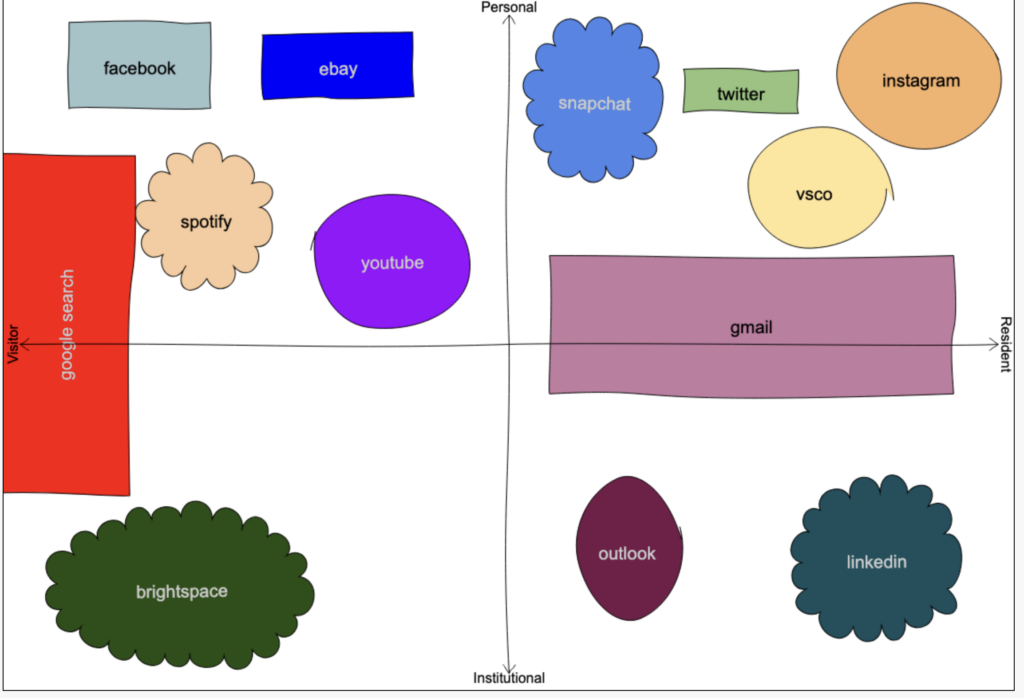
Linkedin is one of the most relevant platforms for students to develop their budding professional networks, as it allows for connections to be made with individuals in potential future career paths, mentorship to take place, advice to be shared and job opportunities to be explored. It allows for students to connect with peers and mentors all over the world and make valuable connections with individuals they may have never known otherwise. This allows for the sharing of new perspectives, the cultivation of ideas and the trading of insider tips that can help a student jumpstart their professional journey into their field of choice. Especially when looking to gain initial experience and find jobs, Linkedin is an extremely helpful tool as it provides easily accessible job posting and internship opportunities, and puts companies that are looking for new hires in the same space.

What Could the Student Consider in Expanding their Professional Learning Network?

There are many ways in which a student could expand their professional learning network. One of the most beneficial ways is through active engagement in opportunities in ones community and taking part as a member in spaces that pertain to areas of interest both professionally and personally. Like Lily said this week in our learning pods, getting engaged by attending conferences and meetings is key when it comes to expanding ones professional learning network. At UVIC, there are many opportunities to do so through co-ops, meeting sessions within fields of study, and clubs and councils that support career opportunities. As a psychology student, I know there are multiple events throughout the year where we can attend, mingle with graduate students and professors, ask questions, gain information on future paths of study and make connections with professionals and peers in areas relevant to us.

How Does Data Privacy and Security Limit and/or Promote a PLN?

Data privacy can limit or inhibit the creation of connections in a personal and professional learning network, as it may be more difficult to connect with others to share ideas if certain individuals accounts are private or if settings are in place to limit comments or direct messages. In our learning pods this week, Lily made a great point about how secure platforms of communication can promote trust within a personal or professional l.earning network, and is a productive way to encourage meaningful and open conversations as there is less worry about factors such as data mining.

In Your Network, How can you Create a Digital Identity and Reputation?

You can create a reputation for yourself online by remaining consistently mindful about the way in which your online presence is portrayed and the implications of what you are commenting and posting online. For me, it is important to refrain from taking part in negative interactions with others online, for example leaving hate comments, posting a harmful video on TikTok, making fun of someone else or being apart of negative forums and chats. It is important to be mindful of the fact that everything we say, post and interact with on the internet contributes to the building of our digital identity, and that we should do what is possible to make sure it is a positive one.

Consider How an Employer Would Respond if you Applied for a Job With Them and They Assessed your Social Media Presence via your Digital Identity

In my opinion based on my review of my own digital foot we completed last week, if an employer assessed my social media presence there would not be any causes for concern. I tend to remain pretty private online, with private social media accounts that I do not post consistently on. I found that everything attached to my name on google was pretty tame and would not raise any red flags if I was applying for a job.

This is my Visitor and Resident Map:

Categories
edci338 Posts

Week Three: Personal Learning Networks and Digital Identity

This week we discussed Digital Identity and Personal Learning Networks, which are two aspects of our society that are continuously growing and becoming more prevalent as technology becomes further integrated into our lives.

Our digital identity is formed just like our offline identity, through our shared understandings, discourses and perceived realities and are made through connections as humans search for meaning and belonging in their lives. Digitally, humans are able to form connections and find spaces where their identity is cultivated through social media platforms like Facebook and Twitter. We are able to create unique and personalized online spaces for ourselves tailored to our sets of interests, opinions, and values. We choose who to follow or friend, who to interact with and what we like. In the learning pods this week, Lily and I related this from our personal experience back to the Identity Making and Social Media article. I talked about how this process can often lead to the false reality that everyone around us thinks the same way as us and holds the same opinions as we do, because this is reinforced by the extreme level of curation. Our digital identity is also formed by the way we present ourselves online, which was touched on in the What is Digital Identity video. The commentator stated that “everything that you post, share, how you engage with and treat other people and how you use digital tools” (Stoller, 2016) are all factors that form our footprint online. This portion of the video can be related to one of the articles we read last week, titled Surveillance and Society. Both the video and this article discussed how our digital footprint can sometimes be a disadvantage of social media and having a digital identity, as others interpretations of how we present ourselves online can sometimes be negative.

The concept of digital identity is also greatly related to personal learning networks. As we discussed last week, our personal learning networks are created through the development of our online and offline identities; thus our digital identity is a part of our personal learning network which is the greater web of all of our connections from which we learn. The Identity Making and Social Media article describes how digital spaces are constantly being used by us to collect information throughout our daily lives and have made it increasingly easy to access to platforms such as newsfeeds, forums about our interests and important social movements.

Our digital identity is also able to relate back to last week’s discussion on professional networks. Professional networks are created through, “the act of making connections with other professionals” (Rajagopal, 2012) and also fall under the larger category of a personal learning network. Professional networks can be facilitated through our digital identity, which is discussed in the article from this week entitled Digital Professional Identity: Dear Internet! Who Am I?. The author describes DPI, or digital professional identity, “that develops through internet based social interactions by utilizing online platforms and communication tools” (Jawed, et al., 2019), and emphasizes the importance of internet communication on the development of a professional identity. It is evident that our digital identities and the professional networks we create are extremely interlinked.

References:

Boyd, D. (n.d.). Surveillance & Society. View of Networked Privacy. https://ojs.library.queensu.ca/index.php/surveillance-and-society/article/view/networked/networked

Jawed, Saira; Mahboob, Usman; Yasmeen, Rahila. Digital Professional Identity: Dear Internet! Who am I?. Education for Health 32(1):p 33-35, Jan–Apr 2019. DOI: 10.4103/efh.EfH_232_17

Rajagopal, K., Joosten–ten Brinke, D., Van Bruggen , J., & B. Sloep, P. (2012). View of Understanding personal learning networks: Their structure, content and the networking skills needed to optimally use them: First Monday. View of Understanding personal learning networks: Their structure, content and the networking skills needed to optimally use them | First Monday. https://firstmonday.org/ojs/index.php/fm/article/view/3559/313

University of Derby. (2016, November 25). Eric Stoller – What is Digital Identity? [Video]. Youtube.

Categories
edci338 Posts

Week Two: PLN’s and Public Communication

What Does it Mean to Network Using Social Media?

Networking through social media can be an extremely useful tool for professionals, as it allows for the formation and renewal of relationships with others who work in similar fields and share the same views and goals. This concept was delved into in the Understanding Personal Learning Networks article, where the ways in which our personal learning networks shape our learning and help us advance our ideas. Personal learning networks can be described as our online and offline connections of people based on our specific interests (Rajagopal et al., 2012). Before social media, professionals would have to meet face to face, and would most likely only be connecting with those who live in the same area. Because of social media, networking can happen any time, any place with anyone. In the Personal Learning Network video, it was stated that our relationship with the internet and social media has been able to change the way we access and seek out information through communication (University of Southhampton, 2022). Using platforms such as LinkedIn or Facebook, individuals are able to be constantly learning from each other, as the exchange of ideas is able to occur instantly. This allows for advancements in many fields to occur at a way faster pace.

When we discussed the topic of networking through social media in our learning pods, Lily made the connection to her experience as a business student. She discussed the importance and advantages of networking and connections to someone starting out in the business sector, and how this has become way easier due to the integration of social media into the professional sector. It would be incredibly difficult to begin a professional career without any insight or guidance from those around you, and without any support from peers in similar situations as you.

What are the Risks & Rewards of Public Communications?

There are many rewards of using public communication, but with those rewards come a few risks. One of the main benefits discussed in the Understanding Personal Learning Networks article are the many ways that public communication is able to enrich and support the growth of careers. This could occur through many different activities such as joining specific associations within a professional sector and creating online organizational spaces to build relationships. Public communication allows for tight-knit communities to be built, and provides professionals with constant support in their endeavours. It was recognized in the text that both strong and weak ties made through public communication actively contribute to one’s learning experience, as strong ties bring forth the collaborative creation of ideas and weak ties can be hubs for new information and ideas (Rajagopal et al., 2012). Public communication is greatly effective way to collaborate with others in professional environments, learn and share information and receive support from peers.

While the internet can be used as a helpful tool in those ways, there are also downsides that come with it. When we use public communications to connect with one another, we create an online image of ourselves that is interpreted by algorithms that are attempting to advertise information or products to us based on the presence we hold online. In the Surveillance and Society article, it was also noted that not just machines are viewing and analyzing the public persona individuals have online. Potential employers, college admissions boards, and even peers and parents are able to see what an individual has posted online, the comments they have made and the social spaces they align themselves with (Boyd, n.d). Often times, especially when people are younger and less aware, they will post videos or photos that may cause opportunities to be withheld from them later in life without realizing how permanent a digital footprint can be.

In our learning pods this week, I discussed the importance of being wary of one’s digital footprint and the ways in which it could be interpreted or judged by others. Olivia reinforced that point when she discussed how, “these days there are hardly any employers that don’t check someone’s social media before sending a job offer” and that it “heavily represents who you are as a person” in the eyes of professionals. I thought this really drove home the severity of how our public connections can be a potential risk, as an individual could be completely qualified for a job position on paper, but be rejected from the position because of their unsavoury online presence.

How are we Motivated to Participate in Networked Publics?

There are many factors that influence the ways in which we participate in networking with others. These motivations are often based on our personal and professional values and goals. The Understanding Personal Learning Networks article outlines this topic well. In terms of professional interests, one may be influenced by factors such as which connections would benefit their career the most, and network to create opportunities for growth and progression. This can often be done through the attendance of specific conferences that would be populated by individuals with knowledge and experience useful to the professional (Rajagopal et al., 2012). In terms of personal values, a professional may be looking for others based on common interests or connections, the reputations of others, what organizations they are connected to or even if they believe they are a good person (Rajagopal et al., 2012). Individuals wish to connect with those who are likeminded, as that would decrease potential for conflict.

References:

Boyd, D. (n.d.). Surveillance & Society. View of Networked Privacy. https://ojs.library.queensu.ca/index.php/surveillance-and-society/article/view/networked/networked

Rajagopal, K., Joosten–ten Brinke, D., Van Bruggen , J., & B. Sloep, P. (2012). View of Understanding personal learning networks: Their structure, content and the networking skills needed to optimally use them: First Monday. View of Understanding personal learning networks: Their structure, content and the networking skills needed to optimally use them | First Monday. https://firstmonday.org/ojs/index.php/fm/article/view/3559/3131

University of Southhampton. (2022). What is a Personal Learning Network (PLN)? FutureLearn. Retrieved September 19, 2023, from https://www.futurelearn.com/info/courses/learning-network-age/0/steps/24644.